Where do the returns come from?
Goldsand earns from processing stablecoin payments and shares the profit with you. It does not lend your money or depend on volatile asset prices.
The short answer
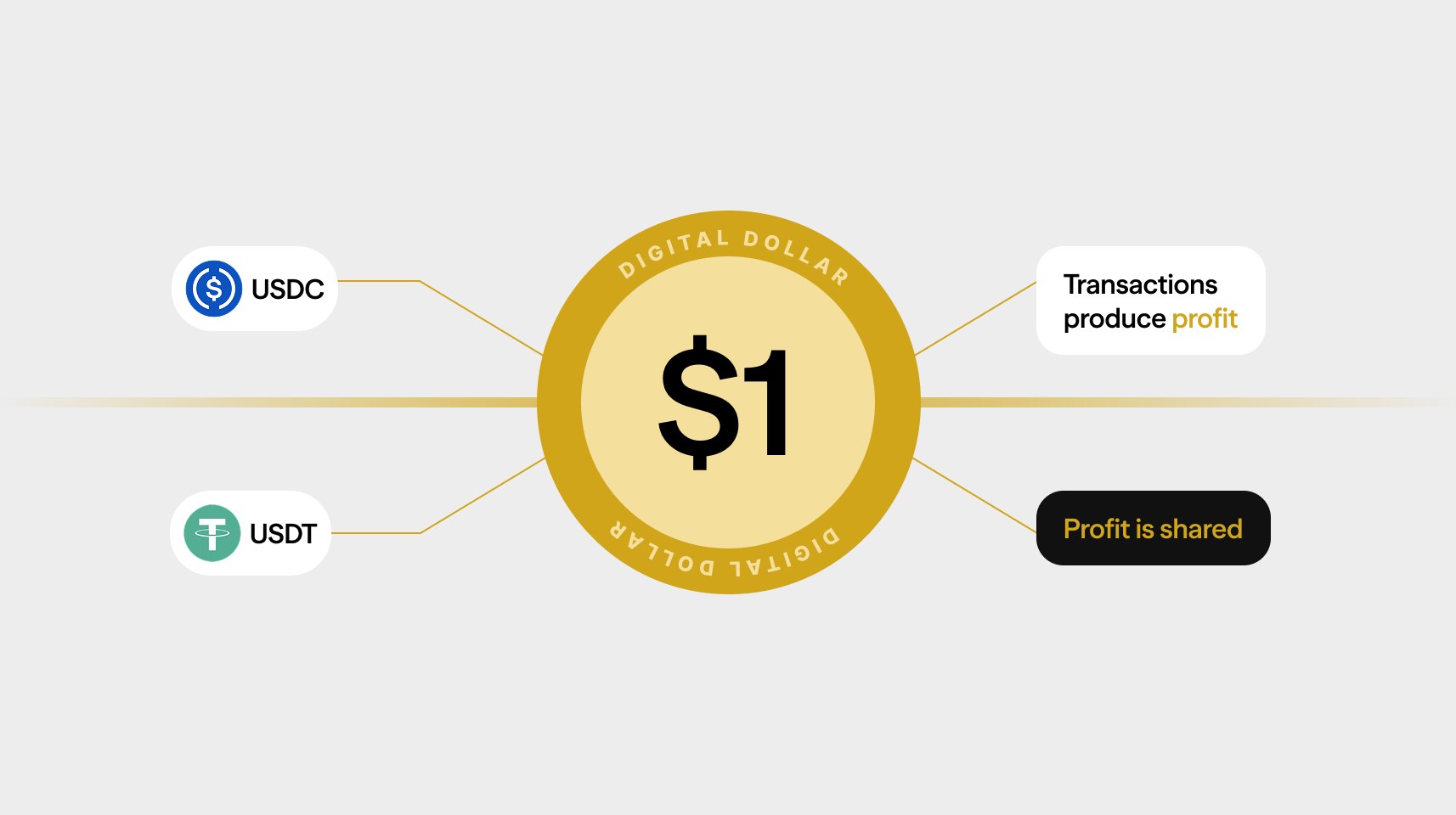
Stablecoins are digital dollars designed to stay near $1. Your capital supports approved stablecoin payments, and you share the profit. Coinbase already earns substantial revenue from stablecoins. Goldsand gives everyday users access to this kind of profit without lending or interest.
Earns from stablecoins
Coinbase
Yes$305M in Q1 2026Goldsand
YesPayment processingShares returns
Coinbase
LimitedMembership requiredGoldsand
YesAgreed profit shareNon-lending only
Coinbase
NoAlso offers lendingGoldsand
YesApproved transactions only| Comparison | Coinbase | Goldsand |
|---|---|---|
| Earns from stablecoins | Yes$305M in Q1 2026 | YesPayment processing |
| Shares returns | LimitedMembership required | YesAgreed profit share |
| Non-lending only | NoAlso offers lending | YesApproved transactions only |
Coinbase information as of July 2026. Its standard USDC rewards currently require Coinbase One membership in several regions, and it separately offers Morpho-powered USDC lending. See Coinbase’s USDC rewards page and lending documentation.
Stablecoins
A stablecoin is a digital dollar designed to remain worth about $1. Goldsand uses established, reserve-backed digital dollars such as USDC and USDT. We select them based on their size, liquidity, track record, and published reserve reports.
Goldsand does not depend on a volatile asset rising in price. Your return comes from processing payments.
Volatile asset
Its market price can move sharply.
Reserve-backed digital dollar
Designed to remain worth approximately $1.
This comparison explains the design goal; it is not a guarantee that a digital dollar can never move away from $1.
$250B+
USDT and USDC in circulation
USDT $183B
USDC $73B
Major payment companies using stablecoins

PayPal
Own stablecoin, available in 70 markets

Visa
130+ payment programs in 50+ countries

Mastercard
Settles card payments with stablecoins

Western Union
Own stablecoin for international payments

MoneyGram
USDC cash access across a 300,000-location network
Revolut
Spend USDC or USDT from a Revolut card
The circulation figures come from issuer reports. The company notes show different forms of adoption, not comparable circulation figures. Sources: Tether, Circle, PayPal, Visa, Mastercard, Western Union, MoneyGram, and Revolut.
Because the capital stays in stablecoins, your return does not move with volatile asset prices. A stablecoin can still lose its $1 peg in rare cases. We cover that risk and how we reduce it in our separate risk guide.
Transaction fees
Imagine buying a chai at your favorite coffee shop with Mastercard. From your side of the counter, paying takes one tap. Behind that tap, the payment system verifies, routes, and settles the purchase.

The merchant pays a small fee for that work. The fee is split among the companies that make the payment possible, including Mastercard, processors, and banks.
Customer
Taps the card
Issuing bank
Approves the payment
Interchange feeMastercard
Routes the payment
Network feeMerchant bank
Settles the purchase
Processing feeCoffee shop
Receives the payment
Pays one merchant fee
The coffee shop pays one merchant fee. It is divided among the companies that approve, route, process, and settle the payment.
Stablecoin payment networks work in a similar way. A person or business can send digital dollars to someone across the world. Operators help start, route, record, and complete the payment. They can earn fees for the work they perform.
Stablecoin payments are already large. McKinsey and Artemis estimate that people and businesses made about $390 billion in stablecoin payments during 2025, after excluding trading and automated transfers. See their stablecoin payments analysis.
Sender
Sends digital dollars
Sending operator
Starts the payment
Processing feeStablecoin network
Moves and records value
USDCUSDTNetwork feeReceiving operator
Completes the payment
Service feeRecipient
Receives money anywhere
Like a card payment, a stablecoin payment can involve several operators. Each may earn a small fee for the work it performs; the exact path and fees depend on the transaction.
Profit sharing, not interest
One transaction earns only a tiny amount. The same capital can help process many transactions over time, so those small amounts add up. That is how Goldsand earns the profit rates shown in the app.
Buying Mastercard stock exposes you to everything Mastercard does. Goldsand works at the transaction level, so your capital is limited to powering zero interest, low risk transactions.
Payments around
the world
Many transactions generate small profits.
Approved
activity only
Interest and lending are filtered out.
ExcludedGoldsand shares the profit
Actual profit is shared with you.
Profit → Your shareSmall profits from many approved transactions can stack up. Your return is your agreed share of the actual profit.
Your return comes from actual profit. It is not fixed interest, so it can rise, fall, or be zero. It is not guaranteed.